Melrose & Borders
Scotland 2025 - Part 2
Monday:
Overcast in the morning, but sunnier in the afternoon. Highs around 70.
Continued from: Scotland 2025 — Edinburgh
In Melrose, we checked into our self-catering cottage, a converted horse stable. It had a bedroom, living room, kitchen, and two bathrooms. The hosts provided a gift basket with cider, chips, chocolate, and ginger cookies.
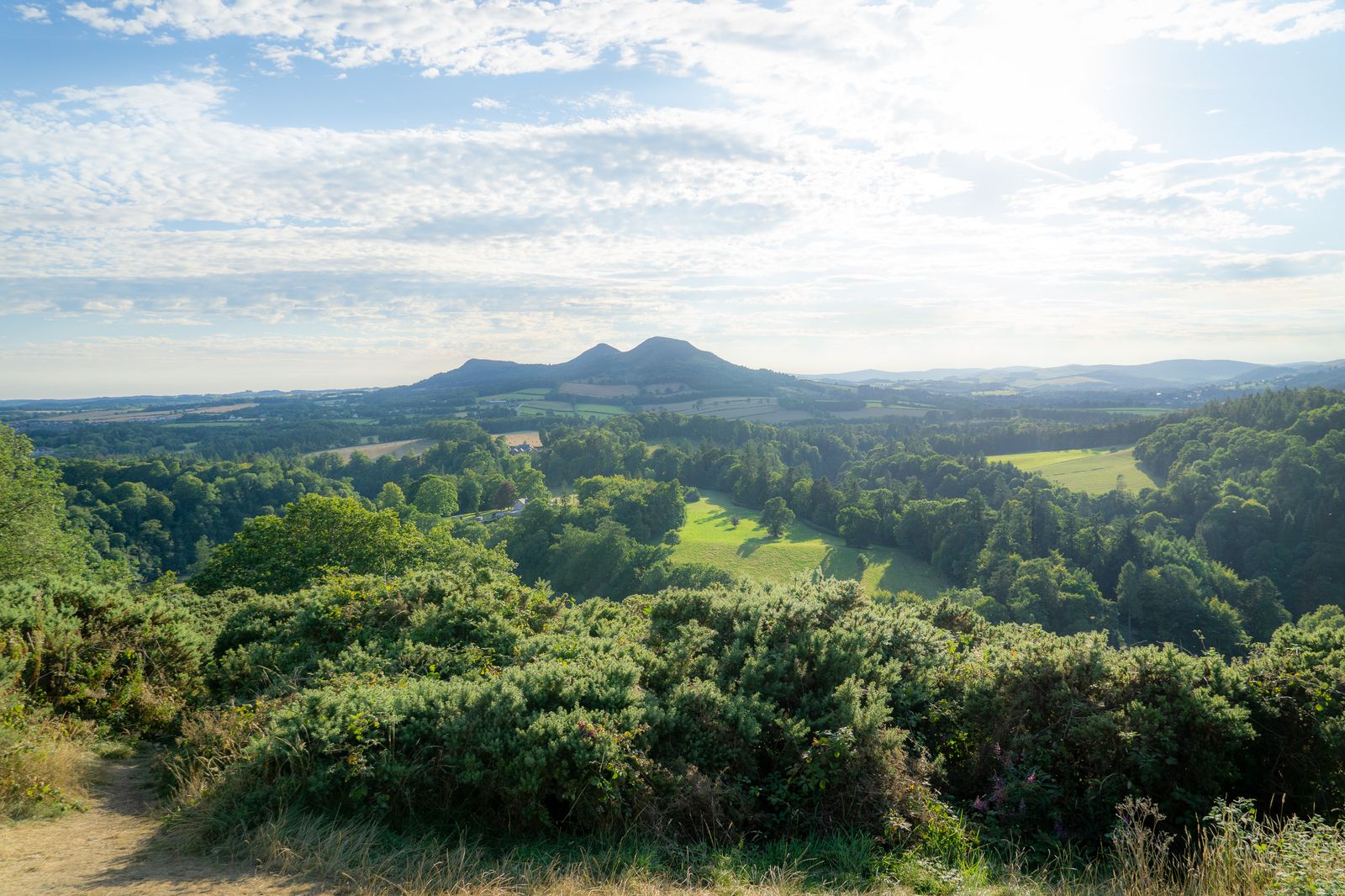
We drove up to Scott’s View, a favorite stop for Walter Scott. The story is that during his funeral procession, his horses stopped at the view as was their usual habit when Scott traveled that route.
We went into Melrose for dinner at Burt’s Hotel. We parked in a public lot and walked, only to discover free spots right in front of Burt’s. Brad had pork schnitzel and Joy had fish & chips, with focaccia and potato/leek soup for starters, and sticky toffee pudding and honey custard tart for dessert.
Our last stop for the day was a Tesco Extra in Galashiels. We bought candy for the kids, Irn-Bru 1901 for Brad (the original recipe for Irn-Bru with no artificial sweeteners), and Walter crisps.
Tuesday:
Cool, rainy, and misty. Highs in the low 60s.
We drove into Melrose for breakfast at a restaurant called Apples. The restaurant was run by two young women and had a non-stop Taylor Swift playlist going. We had a breakfast bagel sandwich and a Belgian Liege waffle. Afterwards, we walked around town and used the public toilets before heading off to Floors Castle.
Floors Castle is the largest inhabited home in Scotland. The 52,000 acre estate has a wind farm and forestry industry. The staff were prepping for a multi-million dollar project to replace the lead sheet roof.
From the house, you can see the holly tree where James II was killed during the Siege of Roxburgh. The fifth Duke of Floors was elevated from Earl by Queen Anne for his support of the Act of Union in 1707. The English government got much of their support for the Union by such means.
The Needle Room had Henri Matisse paintings and a Charles I needlework cushion. The house was full of Chinese figurines and giant Chinese vases. A large 17th-century French tapestry hangs in the great hall. UV blocking glass is used in the windows to prevent damage to the tapestry.
The bird room (full of stuffed birds) had an American Passenger and a Great Bustard, the heaviest flying bird. The room had cases and shelves all along the walls and in the middle of the room for the collection.
The Millennium Garden was full of Scottish apple cultivars. The Bloody Ploughman cultivar comes with a legend that the apple tree grew near the grave of a ploughman executed for stealing apples. We visited the walled garden and the greenhouses with tomatoes growing from vines running along the slanted roof.
Our next stop was Smailhom Tower, a peel tower. Peel towers were built throughout the Borders to protect families during cattle raids from border reivers. Walter Scott frequently visited the tower when he lived in the Borders as a child. His grandfather owned the surrounding land and a young Walter was sent to the countryside when sick with polio. He fell in love with Borders history and stories.
The tower is set up with a few different rooms focusing on Walter Scott and folklore history, with an excellent self-guided audio tour.
We went to Ednam House Hotel for afternoon tea. We had the lounge all to ourselves. Tea included sausage rolls, salmon sandwich, egg sandwich, ham sandwich, scones with cream and tarts.
Our last stop of the day was a TK Maxx (the British name for TJ Maxx) for a blanket and a bonus Irn-Bru, then back to the stables to relax.
We enjoyed a quick and easy McDonald’s meal for dinner. At the time, the Big Arch was not available in the US so Brad enjoyed that novelty and Joy had a Filet-o-Fish sandwich.
Wednesday:
Cool and cloudy with a little rain. Overcast in the morning. Highs in the low 60s.
For breakfast on Wednesday, we went to Marmion’s Brasserie in Melrose. Brad had a bacon roll and Joy had fried eggs on toast, a classic Scottish breakfast. We chatted with a couple of ladies at the table next to ours - one from Cornwall and the other a local.
Our first stop of the day was the Leaderfoot Viaduct, built in the 1860s as a railway bridge over the River Tweed. A footpath leads down to and under the viaduct. From the path, you can see three generations of bridges: The 1860s viaduct, a stone bridge from the 1790s, and the modern highway bridge.
Our big sight for the day was Abbotsford, Walter Scott’s famous home just outside of Melrose. Scott popularized the modern novel and was a celebrity in his day. His home is an eclectic mix. The architecture is a mix of medieval, Scottish, and fairy castle. The house had the first gaslights in Scotland.
Like Floors Castle, Abbotsford sits on the Tweed. It was in the study here that Scott wrote his way out of bankruptcy, spending hours each day at his writing desk.
The armory was stuffed with guns and bladed weapons, including Rob Roy’s dirk and sword. The dining room table seated 30 and the ante-room had a stained glass window replicating the famous heads from Stirling Castle.
Scott collected from everywhere. He had a pulpit from the local church and statues from Hadrian’s wall and the Parliament House in Edinburgh. The guide near the front entrance described him as a 19th-century hoarder.
We had an afternoon meal at Ochiltree, the onsite café. We had BLTs, tea, and Appletiser (sparkling apple juice). We bought a copy of Heart of the Midlothian and a Walter Scott biography from the gift shop.
From Abbotsford, we visited Dryburgh Abbey, Scott’s burial site. It’s also the burial site of the famous World War I Field Marshal Sir Douglas Haig. Haig requested a simple soldier’s headstone instead of a monument.
Dryburgh Abbey is also famous for the Dryburgh Abbey Yew, thought to be around 900 years old. The abbey is in ruins now and was in ruins even Scott was buried there in 1832. The section with Scott’s grave is one of the few sections left with a roof.
On the way back to the cottage we stopped at the William Wallace Statue and Scott’s View.
For dinner, we went to Monte Cassino, our favorite restaurant of the trip. It’s run by a first-generation family from Naples. We had focaccia for a starter, Paccheri with cream sauce, and Papa Alfonso (roasted red pepper, mushrooms, tomato and garlic sauce), and tiramasu for dessert. Their focaccia is still our all-time favorite focaccia.
Thursday:
A little warmer with spots of sunshine. Highs in the mid 60s.
Our Thursday morning breakfast was tea, pancakes, and waffles at Abby Bridge Coffee House in Jedburgh.
We drove out to Jacksons at Jedburgh, a working farm that offers tours and a chance to interact with Highland cows. On the way, we got stuck behind a John Deere tractor trimming the hedges along the road. The country roads in the area are technically two lanes but in practice just one lane when a big tractor is involved.
The Jacksons’ farm dog George jumped into our car when we arrived.
The farm has goats, cows, and Herwick sheep from the Lake District. We walked out into their fields and around the property while we waited for the tour to start. Joy made friends with a pygmy goat.
Highland cows were originally black, but were selectively bred for ginger during Victorian times. The story is that Queen Victoria preferred ginger and that started the trend.
For the tour, we drove out into the back fields in a Land Rover and had the opportunity to walk around the fields and interact with the cows after a short tutorial on avoiding getting injured from the horns. The calves were the easiest to pet. The adult cows were more standoffish.
After the Highland Cow tour, we visited the Monteath Mausoleum. The Victorian-era mausoleum was neglected and fell into disrepair over the years but a grassroots campaign raised funds to restore it and make it accessible to tourists.
A key to get inside the mausoleum is available for loan at the Ancrum Pantry. We picked up the key and parked at nearby holiday cottages and walked up the hill. We had to walk quick as the key was due back before the pantry closed for the day.
There was a private tour at the mausoleum when we arrived so we didn’t need the key after all. We returned the key to the Ancrum Pantry at 3:51, with nine minutes to spare.
We went back to Monte Cassino for dinner. We had the same server and sat at the same table as the night before. We had focaccia for our starter and Joy ordered Papa Alfonso again. Brad had Pasta Alessa (fetuccine and lamb ragu).
Friday:
Mostly overcast, but bright and sunny in the afternoon. Highs in the mid 60s.
Our last day in Melrose we had Anne’s Café & Takeaway for breakfast before heading back towards the Edinburgh area and a Saturday morning flight. Anne’s was a small counter-order shop with a few tables. It was popular with local construction workers starting their day.
We had tea and a half breakfast (egg, sausage, tattie scone, beans, toast, jam, and bacon).
For our final stop, we visited the Wallace Monument. We’d seen it in 2017 but it’s worth a repeat. In 2017, we walked all the way to the top but we took the shuttle this time and walked on the way down. Our shuttle driver was a cranky but funny local man impatient for his lunch break.
The monument is organized into three levels: Hall of Arms, Hall of Heroes, and the Royal Chamber. On top is the Crown Spire with views of the town and the site of the Battle of Stirling Bridge.
The Hall of Arms has William Wallace’s sword. It was refurbished by order of James IV. Walter Scott described the sword as “fit for an archangel to wield, yet light in his terrible hand”.
We had tea at the Sundial Café (tea, bacon roll, carrot cake, and homemade shortbread to go) and headed back to Charlestown for one more night at the Inn at Charlestown before flying home on Saturday.
It was bright and sunny when we got back to Charlestown so we walked out onto the Limekilns Pier. The locals were out soaking up the sun.